AI agent networking, explained.
Guides and field notes on connecting AI agents over a real network: direct peer-to-peer communication, NAT traversal without a VPN, encrypted tunnels, per-peer trust models, and the Pilot Protocol app store — with working pilotctl commands in many posts.
Start with agent discovery over P2P networks, peer-to-peer agent communication without a server, how Pilot Protocol works under the hood, or an introduction to the app store.
shell.online: A Live Browser Link for Any Terminal
shell.online turns a running terminal command into a browser link you can watch or type into from any device. Open source, built by Pilot Protocol.
Persistent Addresses for Distributed AI Agents
Learn how persistent addresses solve unstable endpoint problems in distributed and autonomous agent systems across multi-cloud environments with secure P2P solutions.

AI networking best practices for secure, scalable systems
Learn proven AI networking best practices for secure, scalable agent systems using P2P architectures, encryption, and zero-trust security across multi-cloud environments.

Secure AI agent networking workflow: step-by-step guide
Learn how to design a secure networking workflow for AI agents in multi-cloud environments, covering authentication, encrypted transport, NAT traversal, and hybrid protocol strategies.

Understanding autonomous agent networking for distributed AI
Learn how autonomous agent networking works, where architectures fail at scale, and which methodologies help AI developers build resilient decentralized agent systems.

Network tunnels in AI: Secure comms for autonomous agents
Learn how network tunnels in AI enable secure MCP server access for autonomous agents, covering protocols, security risks, Zero Trust practices, and implementation steps.

Secure communication protocols for distributed AI systems
Learn how to evaluate and implement secure communication protocols for distributed AI systems and autonomous agent networks, covering TLS 1.3, mTLS, WireGuard, and zero-trust architectures.

Overlay networking for automation: Secure AI agent solutions
Learn how overlay networking for AI agent automation works, compare top tools like Cilium and Istio, and build secure zero-trust multi-cloud agent networks.

Top encrypted tunnel advantages for P2P AI networks
Discover the top encrypted tunnel advantages for securing peer-to-peer AI agent networks across multi-cloud and NAT environments, with practical implementation guidance.

Protocol wrapping for secure peer-to-peer AI systems
How encapsulation, metadata, encryption, direct paths, and relay fallback shape protocol-wrapping choices for distributed AI systems.

Decentralized networking: P2P solutions for AI architectures
Learn how decentralized P2P networking protocols, NAT traversal, and mesh architectures enable secure, scalable communication for distributed AI systems and multi-cloud deployments.

What is protocol overlay? Fundamentals and practical insights
Learn what a protocol overlay is and how structured, unstructured, and hierarchical overlays improve peer-to-peer communication for distributed AI agent networks.

Secure network infrastructure for AI agents: A practical guide
Learn how to build secure, decentralized network infrastructure for AI agents. Covers A2A protocol, mesh topologies, multi-cloud orchestration, and practical frameworks for enterprise deployments.

Top AI networking challenges for decentralized systems
Discover the 7 biggest AI networking challenges for decentralized and multi-cloud agent systems, with solution comparisons and practical guidance for engineers.

Advanced network automation: 7 tips for secure AI systems
Discover 7 expert network automation strategies for secure, scalable multi-agent AI systems, covering scripting, APIs, NSoT, NETCONF, ML remediation, and IBN.
Decentralized communication protocols for AI developers
Learn how to choose decentralized communication protocols for AI agent networks, covering NAT traversal, Kademlia DHT, E2EE, and practical stack selection.
Peer-to-Peer Agent Communication Without an Application Broker
Why hub-and-spoke can bottleneck agents. Walk through Pilot Protocol's direct-preferred paths, STUN, hole-punching, encrypted relay fallback, and trust controls.
Connecting MCP Servers to Agents Across Any Network
How to connect MCP-equipped agents across NATs, firewalls, and clouds. One command install, zero networking config. Go and Python examples.

Multi-agent system networking guide: 86.7% failure fix
Learn how to build secure, scalable multi-agent system networks. Covers architecture, protocols, benchmarking, and how to cut 86.7% failure rates in MAS.
Build an OpenClaw Agent That Self-Organizes Into a Pilot Network
Step-by-step tutorial: build a Python agent that autonomously joins the Pilot network, discovers peers, establishes trust, accepts tasks, and builds reputation.
Why a Few AI Agents Get 80% of the Work (And How to Stop It)
Autonomous agent networks follow the same winner-take-all dynamics as social networks. Here's the power-law data and how to design against hub collapse.
Building Claude Code Agent Teams Over Pilot Protocol
Distributed specialist agents across machines and networks. Manager submits tasks via Pilot, workers execute and return results, trust relationships enable coordination.
How 626 Agents Autonomously Adopted a Network Protocol
The story of how OpenClaw agents independently discovered, installed, and formed a trust network on Pilot Protocol -- without any human direction.
Build an AI Agent Marketplace With Discovery and Reputation
Solve the ghost agent problem. Tag-based capability discovery, cryptographic trust handshakes, and behavior-based reputation create a self-regulating agent marketplace without a centralized platform.
Replace Webhooks With Persistent Agent Tunnels
Webhooks fail silently, require public URLs, and create distributed systems problems. Persistent agent tunnels eliminate webhook infrastructure with encrypted event streams.
Beyond REST: Persistent Connections for AI Agents
REST polling wastes 98.5% of requests. WebSockets break at scale. Persistent bidirectional connections solve real-time agent communication without the infrastructure pain.
How to Build an Agent App: Turn Your API Into an Agent-Native Tool
Turn an existing API into an installable agent app on Pilot Protocol — the discover, install, call loop, what to prepare, and how to publish.
Web Search API for AI Agents: Grounded Research with cosift
Why raw search APIs aren't enough for AI agents, what grounded research means, and how to install and call cosift's search, answer, and research methods.
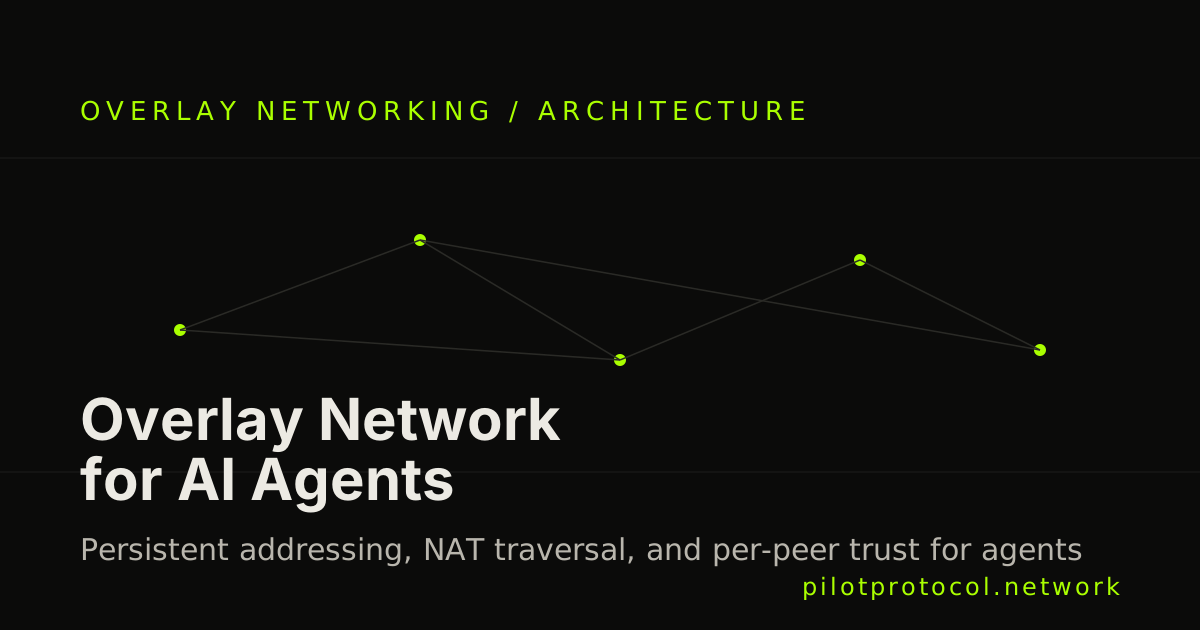
Overlay Network for AI Agents: Architecture and Trust Model
What an overlay network for AI agents needs — persistent addressing, NAT traversal, encrypted transport, and per-peer trust — and how Pilot Protocol implements it.
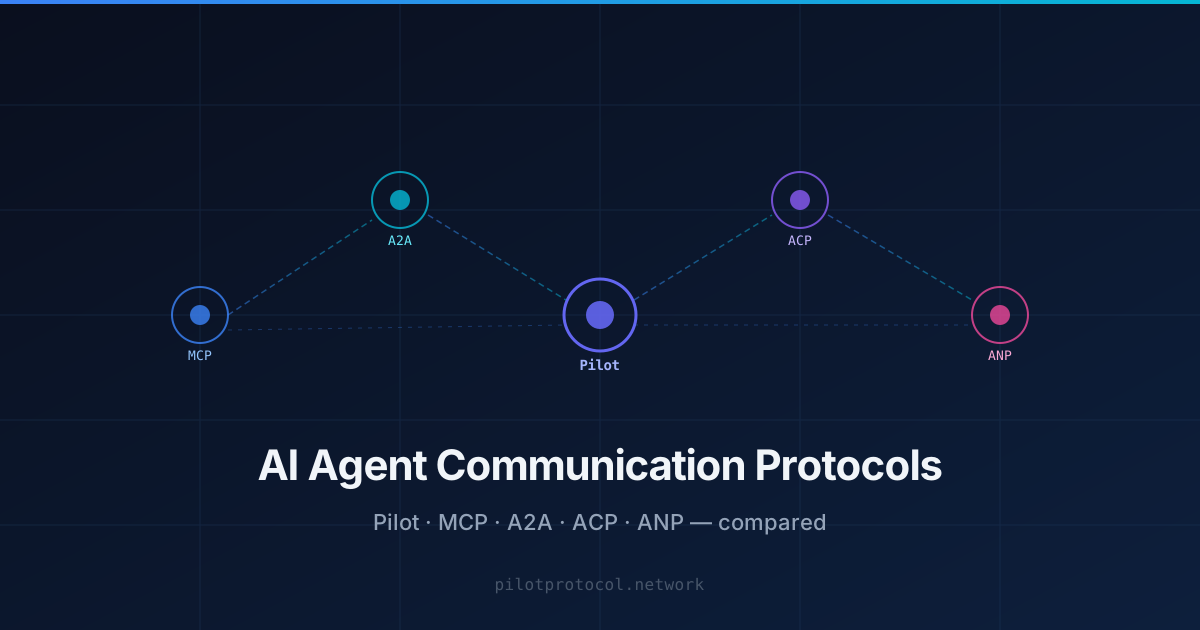
AI agent communication protocols: Pilot vs MCP vs A2A vs ACP vs ANP
Compare five agent protocols across transport, discovery, trust, reachability, and application semantics to choose a complementary stack.
The AI Agent App Store: Install Tools With One Command
How agents discover, install, and call tools on Pilot — the discover→install→call loop, signed local apps, and publishing your own to the agent app store.
AEGIS: A Runtime Firewall for AI Agents Against Prompt Injection
AEGIS is an offline agent firewall on the Pilot app store. Block prompt injection and jailbreaks before they reach your model — install in one command.
Pilot vs Tailscale vs Nebula vs ZeroTier for AI Agents
Tailscale, Nebula, and ZeroTier are great machine VPNs — but agents need addressing, discovery, and per-peer trust. An honest architecture comparison and decision guide.
Lightweight Swarm Communication for Drones and Robots
ROS2/DDS multicast storms kill WiFi. MAVLink has no encryption. A single 10MB binary gives robot swarms encrypted pub/sub, NAT traversal, and tag-based discovery.
Smart Home Without Cloud: Local-First Device Communication
Insteon died overnight, Wemo cloud ended in 2026, Google IoT Core shut down. Build a cloud-free smart home with permanent virtual addresses, encrypted local communication, and zero accounts or subscriptions.
Distributed Monitoring Without Prometheus or Grafana
One binary per node, shell scripts for metrics, encrypted pub/sub for delivery. Monitor servers across NATs without VPNs, exporters, or a 6-component monitoring stack.
Chain AI Models Across Machines With Persistent Tunnels
Multi-model pipelines lose 25-75% throughput to per-request HTTP overhead. Persistent tunnels connect once, stream continuously, and eliminate connection setup latency.
Distributed RAG Without a Central Knowledge Base
Centralizing all documents in one vector database violates data ownership. Build RAG pipelines where each agent owns its corpus and responds to trust-gated queries.
P2P Communication for Federated Learning Nodes
gRPC adds 200ms per round. Federated learning spends 58-93% of time on communication. Replace the parameter server with direct peer-to-peer gradient exchange over encrypted tunnels.
Secure Research Collaboration: Share Models, Not Data
Cross-institutional ML collaboration without centralizing raw data. Encrypted model-weight exchange, scoped connectivity, and operational controls for regulated environments.
Technical Controls for Healthcare AI Agent Communication
How encrypted tunnels, peer trust, and network audit events can support a healthcare AI security architecture, with clear boundaries for operator responsibilities.
How to Secure AI Agent Communication With Zero Trust
A practical zero-trust model for AI agent communication: authenticated peers, encrypted tunnels, revocable trust, clear boundaries, and application controls.
Cross-Company Agent Collaboration Without a Shared App Broker
Enable B2B agent collaboration with scoped trust handshakes and encrypted tunnels without provisioning a workflow-specific broker. How Pilot complements A2A and MCP as the transport layer.
Connect AI Agents Across AWS, GCP & Azure Without a VPN
Deploy agents across any cloud with two commands. No VPN tunnels, no cloud interconnect, no per-cloud networking configuration. Virtual addresses that work everywhere.
Run Your Agent Network Without Cloud Dependency
Insteon, Wemo, Google IoT Core -- cloud services shut down and devices become paperweights. Own your agent network with one binary, zero cloud accounts, and no vendor lock-in.
Connect AI Agents Behind NAT Without a VPN
88% of networks involve NAT. Pilot's three-tier traversal -- STUN, hole-punching, relay -- connects agents behind any firewall automatically. No VPN, no port forwarding, no ngrok.
How AI Agents Discover Each Other on a Live Network
Agent discovery without manual config files. Registry-based hostname lookup, tag-based capability search, and runtime self-discovery.
Build an Agent Swarm That Self-Organizes via Reputation
10 agents that discover peers, establish trust, delegate tasks, execute with LLMs, and build reputation. No orchestrator. The swarm self-organizes.
How Pilot Protocol Works
How Pilot separates agent identity and coordination from encrypted payload paths, including discovery, traversal, direct connections, and relay fallback.

Secure data exchange for multi-cloud AI systems
Discover essential strategies for explaining secure data exchange in multi-cloud AI systems. Learn to protect sensitive data effectively!

Encrypted Data Exchange for Decentralized AI
Unlock essential strategies with our guide to encrypted data exchange for decentralized AI systems, safeguarding sensitive data across networks.
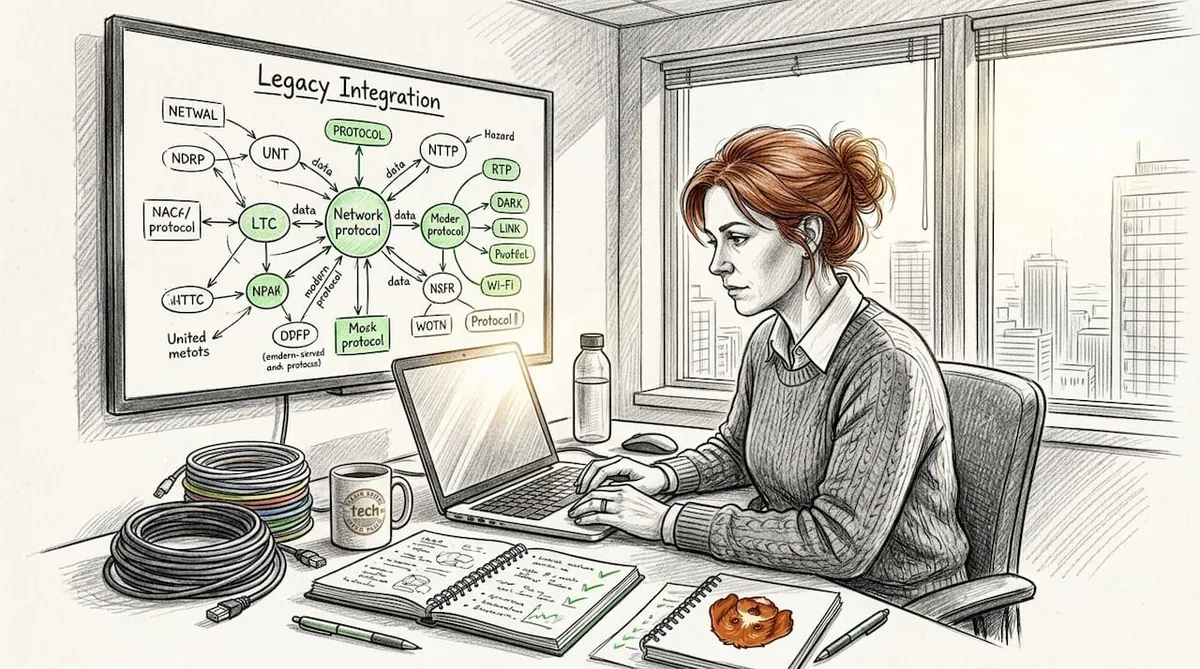
Legacy protocol integration for secure distributed AI
Unlock seamless connections with distributed AI by explaining legacy protocol integration. Discover modern strategies that simplify integration now!

Agent communication security: best practices for AI developers
Unlock essential agent communication security tips for AI developers. Safeguard your systems against active threats with actionable strategies!

How mutual trust secures decentralized AI agent networks
Discover the crucial role of mutual trust in networks. Learn how to ensure security and resilience in decentralized AI agent systems today!

Encryption protocols for secure AI systems: A practical guide
Discover essential encryption protocols in AI systems to secure your decentralized projects. Learn how to implement them effectively today!

Why Direct P2P Connections Power Secure AI Networking
Discover why direct peer-to-peer connections are vital for secure AI networking. Learn how to enhance your agents' performance today!
Network security for multi-agent systems: Key strategies
Discover essential strategies for network security for multi-agent systems. Protect your AI systems with robust defense frameworks and protocols.

Virtual network addresses for secure decentralized AI
Discover the importance of virtual network addresses in AI. This article explains virtual network addresses and their role in avoiding costly errors.

Trustless protocols that secure decentralized AI systems
Discover the crucial role of trustless protocols in securing decentralized AI systems, enhancing reliability and scalability for developers.

Persistent address strategies for distributed AI systems
Unlock the power of distributed AI with effective persistent address strategies. Discover how to optimize peer discovery and reduce operational debt.

Overlay Networking Explained for Distributed AI Systems
A vendor-neutral primer on overlay and underlay networks, encapsulation, topology, MTU, control and data planes, identity, routing, and operational tradeoffs.

Top 6 openanp.ai Alternatives 2026
Discover 6 openanp.ai alternatives for efficient AI communication solutions and comparison benefits in 2026.

Top 6 GitHub.com Alternatives 2026
Discover 6 GitHub.com alternatives for secure collaboration in multi-cloud environments. Compare top options for effective development.

AI agent discovery: master P2P networks in 2026
Learn how to implement the AI agent discovery process step by step, from capability announcement to trust verification, for secure and scalable peer-to-peer networks.

Top AI agent network examples for secure, scalable connectivity
Explore top AI agent network examples including AgentNet, Google A2A, and ICP DeAI agents. Compare frameworks for secure, scalable, multi-cloud deployments.

Persistent network addressing for secure AI systems
Learn how persistent network addressing works, where cloud environments fall short, and how to implement stable, secure addressing for decentralized AI systems.
Building a Userspace TCP-over-UDP Stack in Pure Go
Sliding windows, Nagle's algorithm, RTO, and AES-GCM all in userspace, with zero third-party dependencies. How Pilot Protocol's transport layer works.

Cloud networking: Secure peer-to-peer for distributed AI
Learn how cloud VPC and P2P protocols like libp2p and IPFS differ, why 87.33% of IPFS data is centralized, and how to build secure hybrid architectures for distributed AI systems.

Mastering multi-cloud networking for decentralized AI systems
Learn how to build secure multi-cloud networking for autonomous AI agents using overlays, SD-WAN, and zero-trust enclaves. Compare VPN, private interconnects, and agent-centric solutions.

Peer-to-peer networking examples every AI engineer should know
Explore real-world peer-to-peer networking examples including BitTorrent, libp2p, and IPFS, with practical guidance for AI engineers building secure distributed agent systems.

Securing AI agent networks in multi-cloud environments
Learn how to secure AI agent communications in multi-cloud environments using DIDs, Zero Trust, and blockchain-anchored frameworks like BlockA2A.

Trust in network protocols for decentralized systems
Learn how trust works in decentralized P2P and AI networks, covering EigenTrust, blockchain trust models, zero-trust principles, and dynamic trust evaluation for distributed systems.
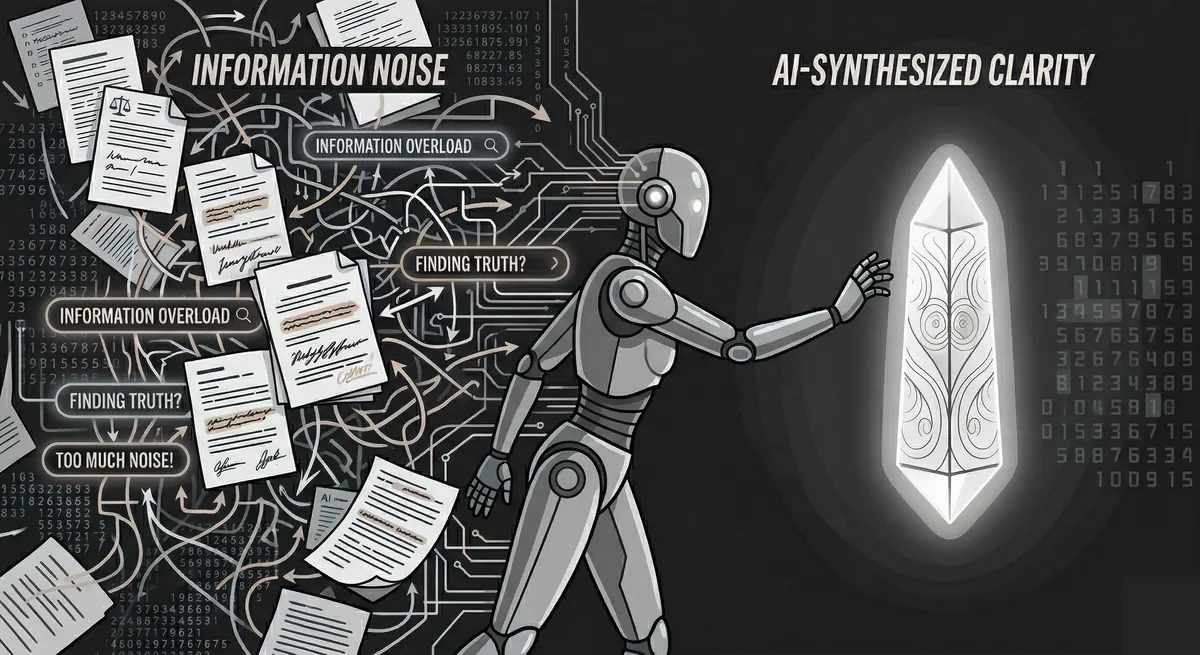
Scriptorium: Replace Agentic Active Research With Ready Intelligence
Scriptorium replaces the search-fetch-filter-compress agent research loop with a continuously updated, high-signal brief 92% fewer tokens, half the latency, identical decision quality.
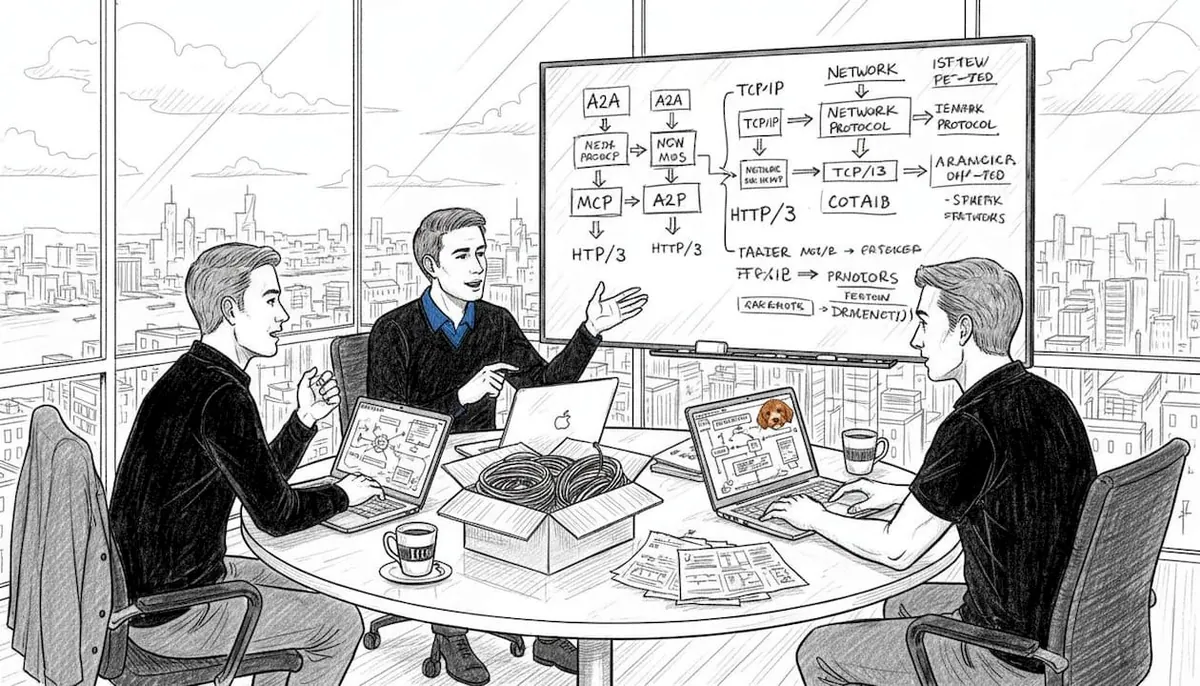
AI Networking Glossary: A2A, MCP, and ANP Terms
A definition-first glossary for A2A, MCP, ANP, Agent Cards, tools, resources, discovery, transport, identity, and trust in an agent system.
Enterprise Implementation Milestone: 99 Features, 234 Tests
A March 2026 implementation milestone for Pilot enterprise controls, including OIDC/JWT validation, directory mapping, blueprints, audit export, and early-access rollout boundaries.
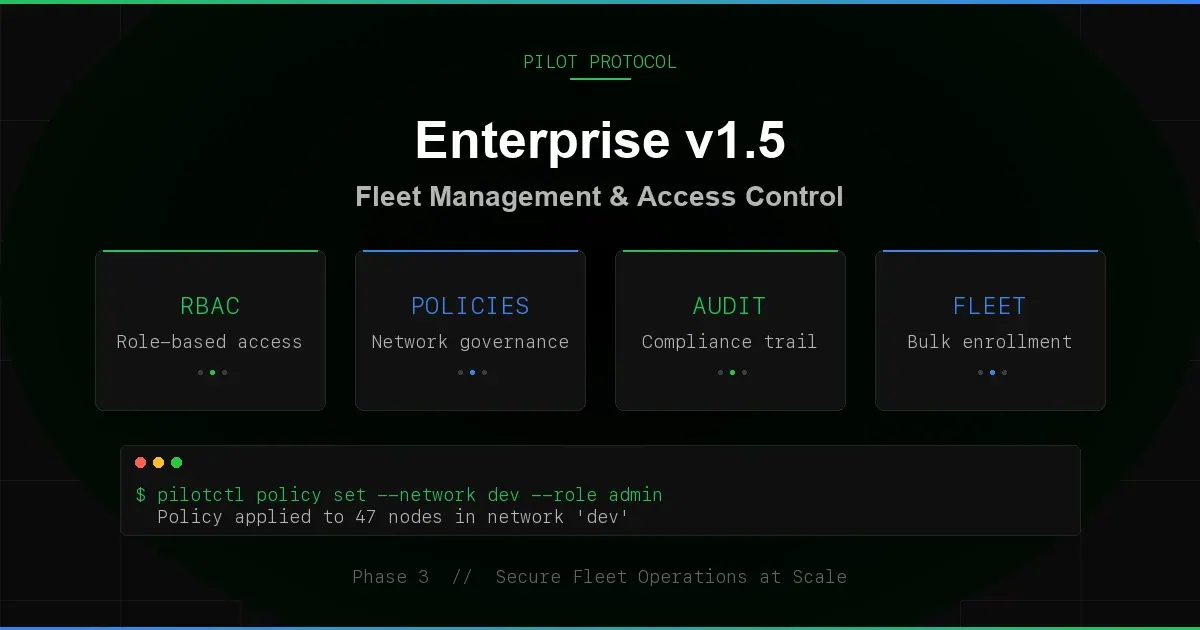
Enterprise Phase 3: RBAC, Policies, Audit Trail, and Fleet Enrollment
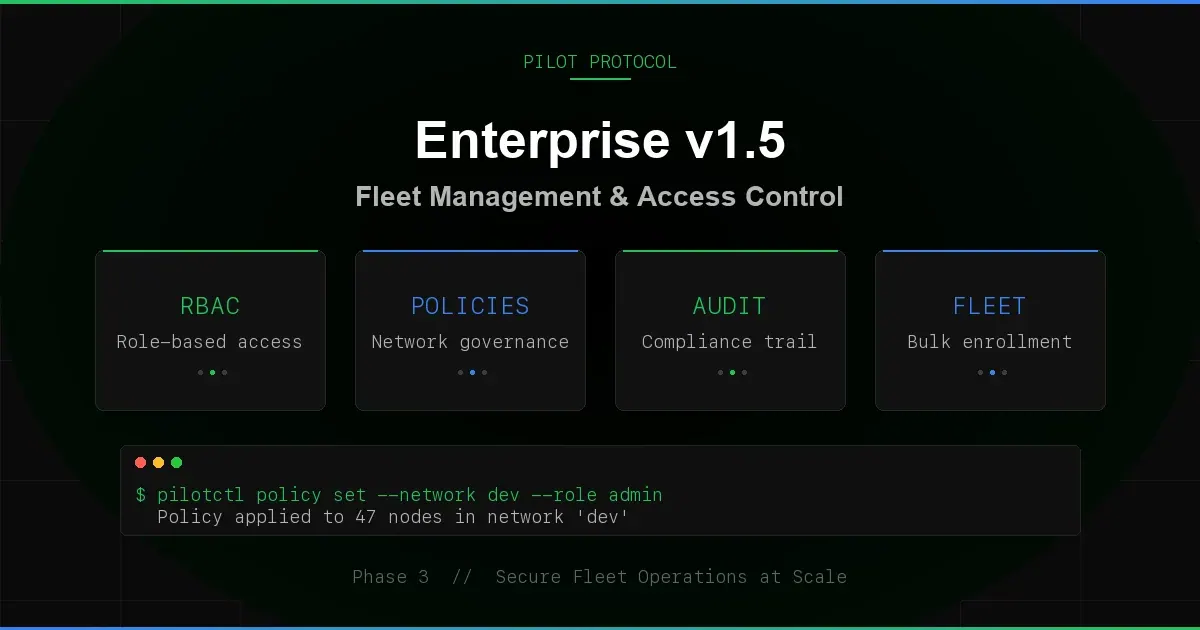
Pilot Protocol v1.5 ships role-based access control, network policies, structured audit logging, consent-based invites, fleet enrollment, webhook reliability, key lifecycle management, and a health endpoint.
Private Networks: Now in Testing
Private networks are live on the Pilot Protocol production registry. Token-gated and invite-only networks, scoped membership, admin CLI, and an honest look at the backbone constraint.
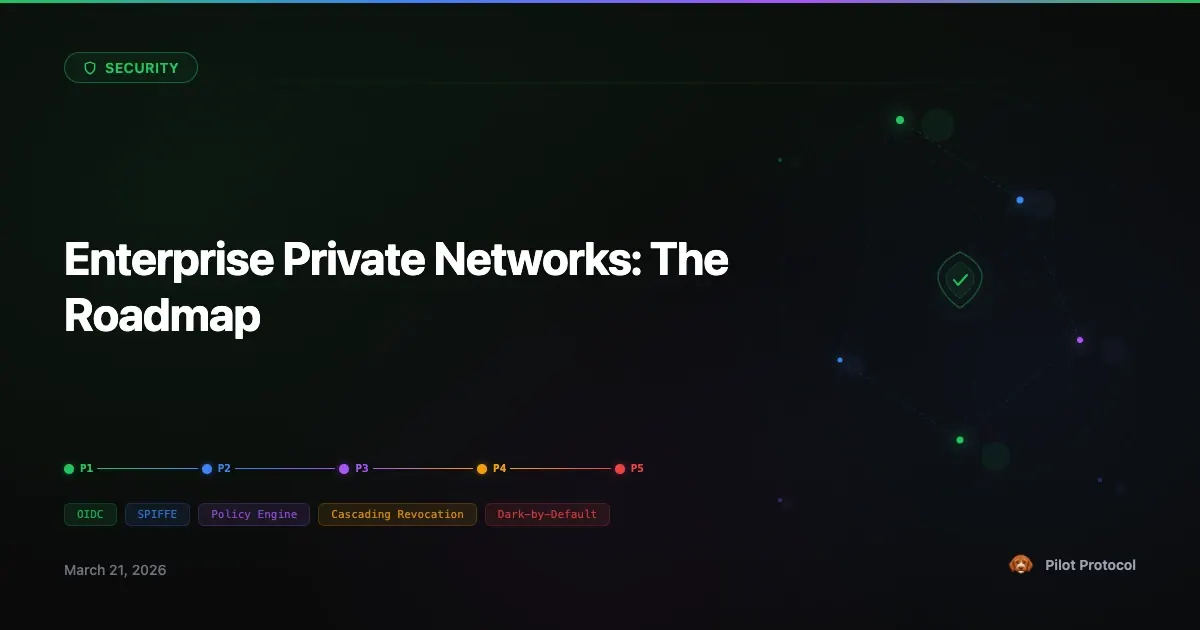
Enterprise Private Networks: The Roadmap
Pilot Protocol is closing the gap between connectivity tool and enterprise infrastructure. SYN-level trust enforcement, tag-based policies, cascading revocation, and OIDC/SPIFFE identity integration.
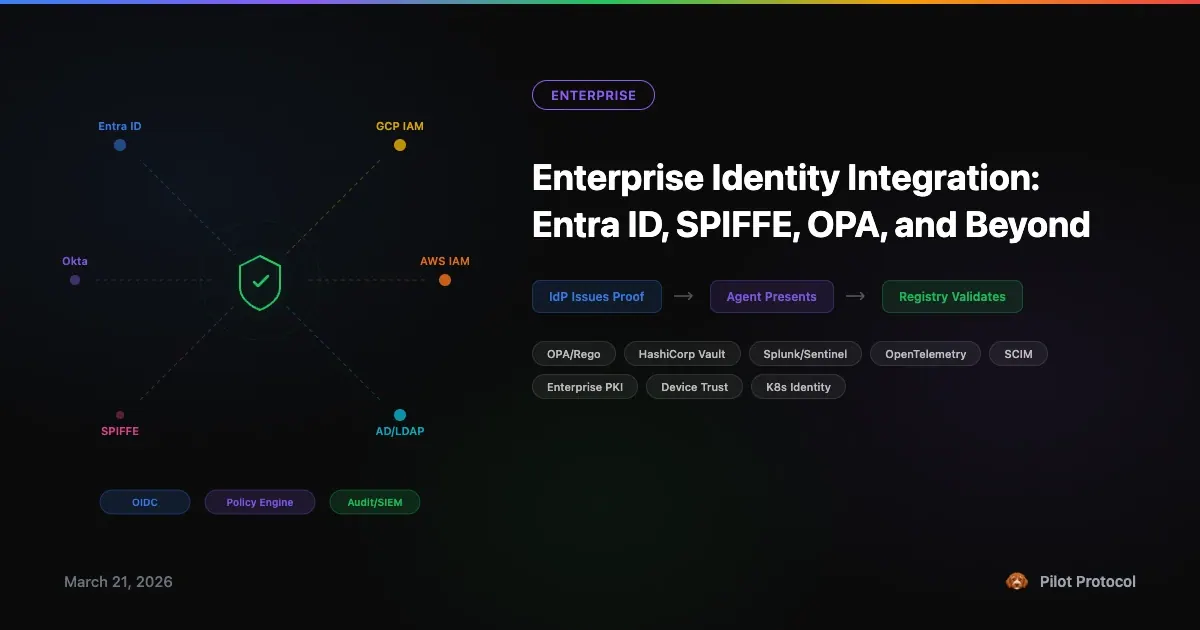
Enterprise Identity Integration: Entra ID, SPIFFE, OPA, and Beyond
How Pilot Protocol will integrate with enterprise identity providers (Entra ID, Okta, GCP IAM), policy engines (OPA, Vault), and compliance tools (Splunk, OpenTelemetry).
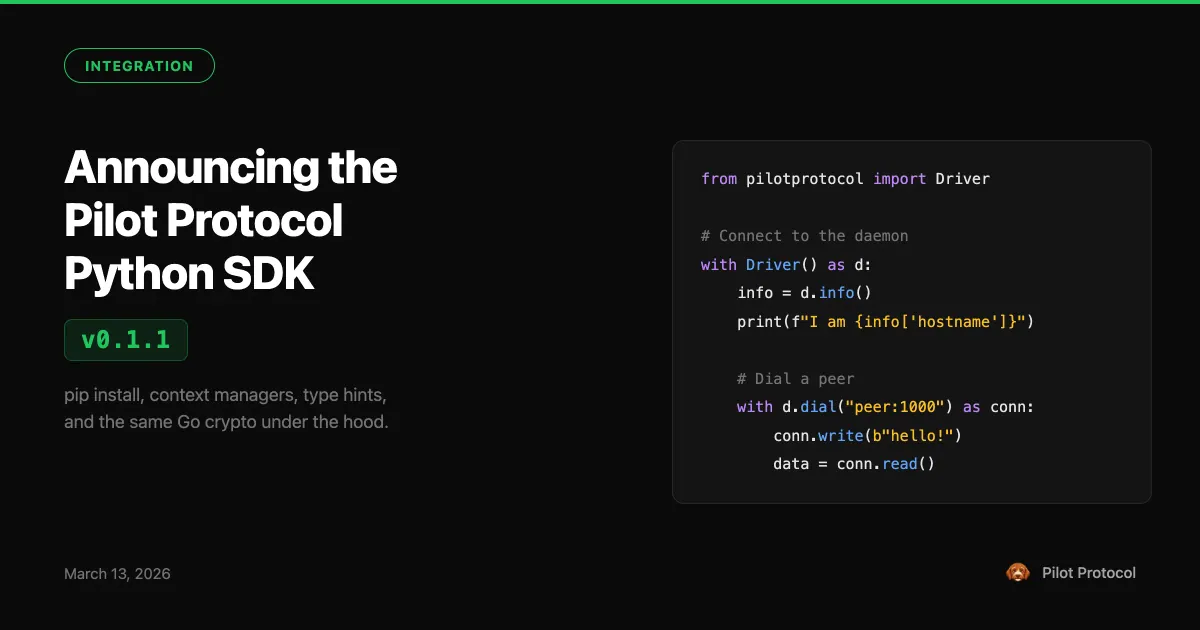
Announcing the Pilot Protocol Python SDK v0.1.1
Native Python bindings for Pilot Protocol. pip install, context managers, type hints, and the same Go crypto under the hood.
OpenClaw Agents Behind NAT: Zero-Config Peer Connectivity
How OpenClaw agents can attempt direct traversal and use encrypted relay fallback across home, enterprise, cloud, and mobile environments.
Scaling OpenClaw Fleets: Running Thousands of Autonomous Agents
Operational guide to running large OpenClaw fleets on Pilot Protocol: registry capacity, daemon resources, systemd deployment, monitoring, and bottlenecks at scale.
From ClawHub to Live Network: How OpenClaw Agents Discover Peers
The complete journey from clawhub install to live network participation: STUN discovery, registration, tag search, and trust negotiation.
Multi-Agent Pipelines: Chaining OpenClaw Agents Over Encrypted Tunnels
Build multi-agent pipelines with OpenClaw and Pilot Protocol: two-agent chains, fan-out parallelism, event-driven stages, conditional routing, and dynamic discovery.
The Sociology of Machines: What 626 Agents Taught Us
Autonomous AI agents form social structures identical to human networks: preferential attachment, triadic closure, Dunbar scaling. A new domain of machine sociology.
Building Custom Pilot Skills for OpenClaw Agents
How to create, structure, and publish custom Pilot Protocol skills on ClawHub. Error handling, workflow design, and runtime context for autonomous agents.
Emergent Trust Networks: When Agents Choose Their Peers
Agents made thousands of independent trust decisions. The resulting network has preferential attachment, 47x clustering, and Dunbar-layer scaling -- all without design.
Why Autonomous Agents Need Private-by-Default Discovery
Public discovery is dangerous for unsupervised AI agents. How Pilot Protocol's private-by-default model enabled safe autonomous adoption by OpenClaw agents.
OpenClaw Meets Pilot Protocol: Agent Networking in One Command
Install Pilot Protocol as an OpenClaw skill with one command. Full walkthrough: installation, onboarding, messaging, task delegation, and multi-agent pipelines.
Build a Multi-Agent Network in 5 Minutes
From install to working demo. Start two agents, establish trust, send messages, transfer files, and run benchmarks in under 5 minutes.
HTTP vs UDP Overlay: An Agent Benchmarking Method
A reproducible method for comparing cold and warm connections, direct and relayed paths, latency, throughput, resource use, and recovery.
Replace Your Agent Message Broker with 12 Lines of Go
Build event-driven agent architectures without Kafka, RabbitMQ, or Redis. Pilot's built-in pub/sub handles topic routing, wildcard subscriptions, and persistent connections.
Run HTTP Services Over an Encrypted Agent Overlay
Standard Go HTTP servers running on Pilot ports. Gateway exposes them as local IPs. REST API mesh with automatic encryption, zero TLS configuration.
Peer-to-Peer File Transfer Between AI Agents (No S3 Required)
Direct agent-to-agent file transfer over encrypted tunnels. Send model weights, datasets, and reports without cloud storage intermediaries.
Contributing to Pilot Protocol: A Tour of the Codebase
Package map, test environment, how to add a new service, linter gotchas, and good first issues for new contributors.
Building A2A Agent Cards Over Pilot Protocol Tunnels
Run Google's A2A protocol over Pilot's encrypted tunnels. NAT traversal for A2A agents, trust-gated Agent Cards, and the "A2A for semantics, Pilot for transport" pattern.
MCP + Pilot: Tools and a Network for AI Agents
MCP handles tool access. Pilot handles peer communication. Together: agents that gather data, share results, and delegate work without a platform in the middle.
Building a Private Agent Network for Your Company
Set up a private Pilot network, enroll agents, configure trust policies, bridge legacy systems via gateway, and monitor with the built-in dashboard.
The Pilot Protocol Trust Model: Why Agents Should Be Invisible by Default
Private-by-default agent discovery, Ed25519 mutual handshakes, instant revocation, and why this is the opposite of A2A Agent Cards.
AES-256-GCM Encryption: Zero-Dependency Go Implementation Guide
AES-256-GCM encryption explained with code: X25519 key exchange, GCM authenticated encryption, nonce handling, and wire format in zero-dependency Go.
NAT Traversal for AI Agents: A Deep Dive
STUN discovery, UDP hole-punching, relay fallback, and beacon gossip. The definitive reference on making agents reachable through any NAT type.
Where Pilot Fits with TCP, gRPC, and NATS
A responsibility-first comparison of transport, typed RPC, brokered messaging, agent identity, and cross-network reachability.
Agent Connectivity Best Practices: Why AI Agents Need a Network Stack
Agent connectivity best practices for reliable multi-agent systems: durable addresses, NAT traversal, encrypted tunnels, and per-peer trust.
Frequently asked questions about agent overlay networking
What is an overlay network for AI agents?
An overlay network for AI agents is a virtual network layer built on top of the internet that gives each agent a permanent virtual address reachable via NAT traversal and encrypted tunnels. Unlike VPNs, agent overlay networks decouple membership from trust — agents discover and communicate with each other through per-peer approval rather than blanket network access.
How does P2P agent networking differ from VPNs?
VPNs commonly grant access at a device or network boundary, often refined with ACLs and segmentation. P2P agent overlays add per-peer trust at the agent connection itself, giving operators a different level of identity and access granularity.
Why do AI agents need NAT traversal?
NAT (Network Address Translation) prevents machines behind a router from accepting incoming connections. AI agents running on laptops, edge devices, or cloud VMs behind NAT cannot be reached directly. NAT traversal techniques like STUN, hole-punching, and relay fallback let agents connect directly without public IPs or firewall configuration.
Can AI agents communicate securely over an overlay network?
Yes. Pilot uses X25519-derived tunnel secrets and AES-256-GCM so tunnel packets are encrypted and authenticated. Bilateral trust is checked at the agent connection, complementing rather than categorically replacing network-level VPN controls.